Wednesday, October 13, 2010

On to Nebraska

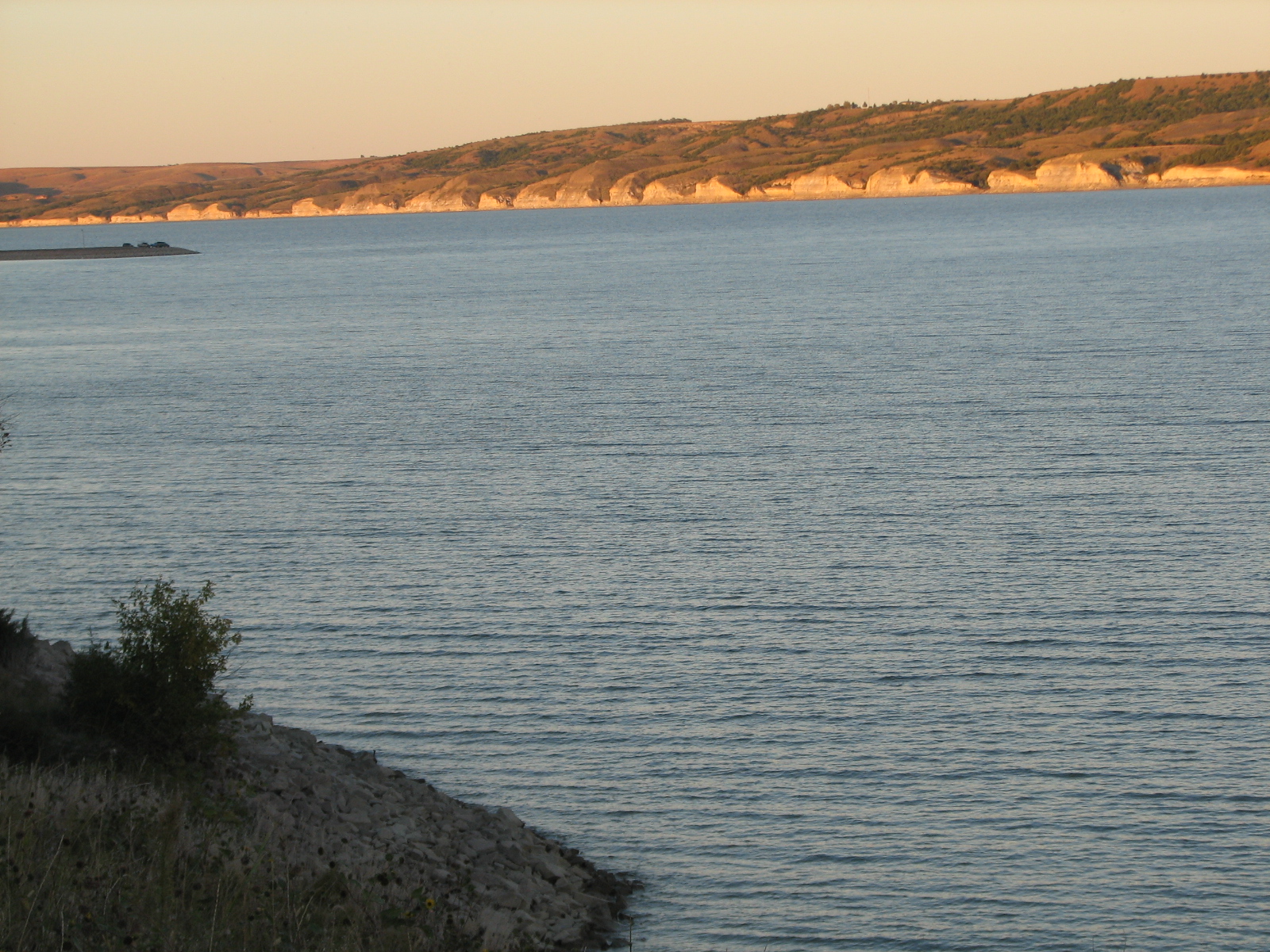
Our first stop after the Black Hills was in the town of Oacoma, right on the Missouri River, or rather, on one of the many lakes that have been created by damming the Missouri at multiple points.  South Dakota refers to this as their version of the Great Lakes, because these lakes are so long, backing up for many miles, and there's a lot of recreational use on them.  But they're not very comparable to the real thing.  Our campsite, however, was excellent, right on the river a few feet from the lake. 

Across the river, in the town of Chamberlain, we found a little treasure - a Native American center and museum built around the St Joseph School, a school for Indian children that has been in existence for many years.  The school has always been focused on teaching only Native American kids, and on emphasizing their culture and history in ways that are glossed over elsewhere. We saw a whole group of the kids, and they seemed so happy, healthy and energetic, and the campus was tranquil as well as beautiful. Likewise the museum.  It's called the Akta Lakota Museum, and the collection was great, the layout very well thought out, and they combined historical artifacts with current work, with an emphasis on quality that we  really appreciated.  We couldn't take pictures, so we can't show the work, but if you ever get here, you should check it out.

At this site, we were mostly doing planning and computer work, and we ran into a problem that is frankly epidemic in these RV parks - that of poor or barely functioning wi-fi service.  Time and time again, we get to an RV park that claims that it has wi-fi and internet service, only to find that the service is intermittent, poor, or available only at a few of the sites.   Then we have to go through all kinds of rigamarole to get our work done.  This site, fortunately, had an arrangement with a motel and resort that was on the same property so that we could use their lobby to set up our computers and go online there.  So we spent a lot of time camped in their facility.  They had a pool, too, so that was fun sometimes.  And there was a nice bike trail nearby, too.


From  here, it was on to Nebraska for a couple of stops.  On the way, we stopped in Mitchell, South Dakota, to visit the legendary Corn Palace, a large community center in the area that is redecorated with corn cobs in various colors every year.  It actually turned out to be a very interesting stop.  The history of the building was fascinating, and there were photos from its first iteration in the nineteenth century up to today, And we found some lovely kitschy items to buy for the grandkids and others.


It was in Mitchell that we discovered a Native American archeological site in a very interesting location.  There was apparently an Indian village near the river here that existed many thousands of years ago and was discovered recently.  The local colleges have cooperated to get a grant to erect a building over the most central part of the site; they have put in a museum nearby and allow tours of the building as well.  The building allows them and their volunteers to work on the site year-round, and provides office space and storage for the work, as well as permitting tourists and visitors to observe and tour the site without disturbing it.  A very clever piece of work.  Ivy and I took the tour and were duly impressed. 
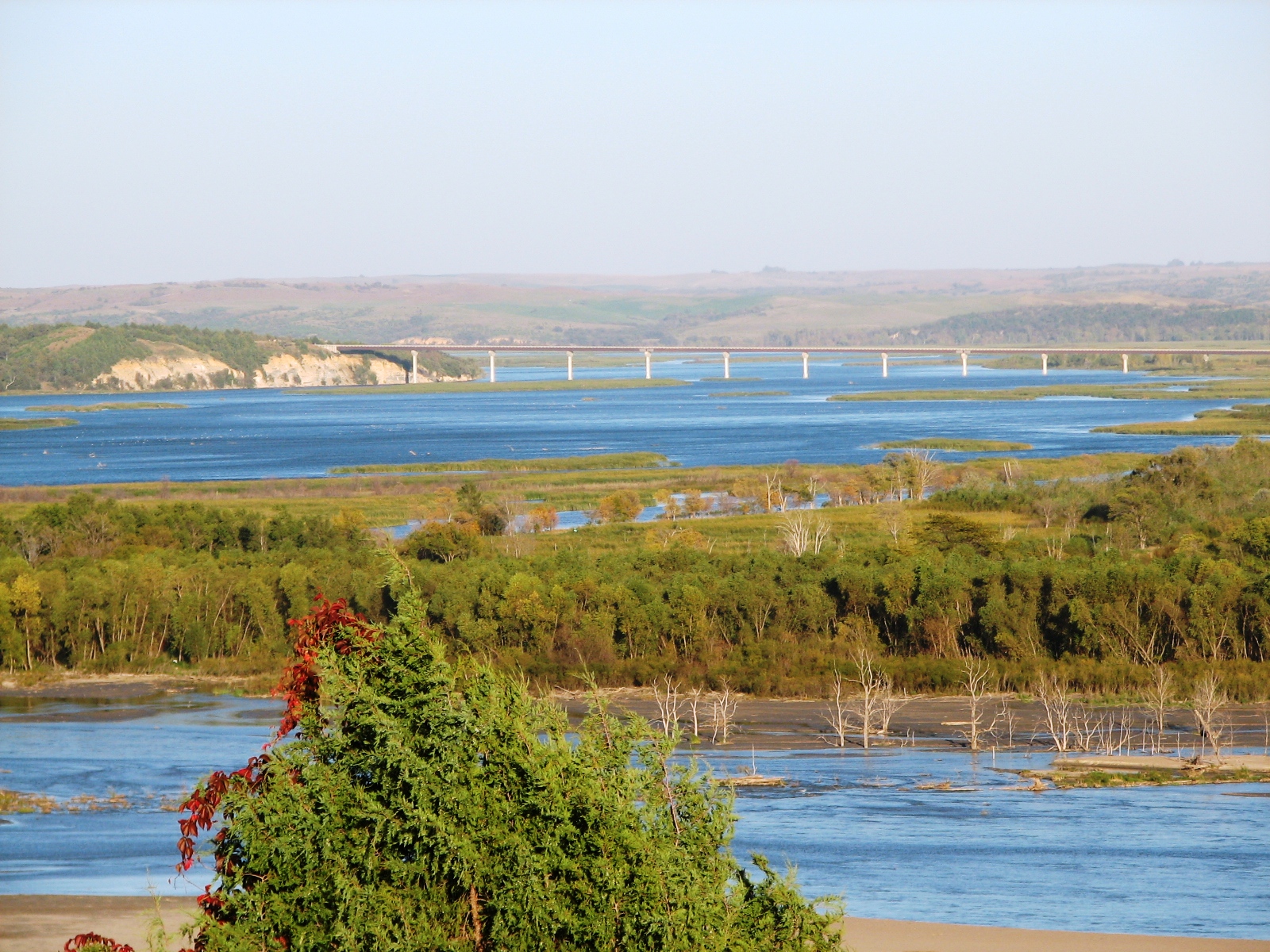
Our stop for the next few days was at the Niobrara State Park, located at the confluence of the Missouri and Niobrara Rivers, on the Nebraska side of the border.  The area is magnificent, with huge river plains on all sides, and the park has a tall bluff with great views.  There are cabins there that are very luxurious for this type of park, and there's a lot of wildlife all through the park.  But we were interested mostly in migratory birds, and that proved quite a disappointment.  I've never seen so vast a plain of waters and marshes with so few water birds on it.  It was surprising to find so much habitat so scarcely populated.  We still are not sure whether the migration was not happening, or whether there was just so much habitat available that the birds had disappeared into it.  Local folks were not knowledgeable and didn't have much to say - that's primarily a hunting and fishing area, like many around that part of the world, and birding knowledge is hard to find.  So after two or three days of wandering around, we moved on. 

We moved on to Omaha, Nebraska.  It was our first really big city stop in several months, and we'd forgotten all about freeway traffic, congestion and smog.  But Omaha refreshed our memory.  It is a lovely and prosperous city that has largely escaped the Great Recession.  Its unemployment rate is about the same as before it all began, so something is going right in this area.  It's a big change from all the For Lease signs that we've been seeing everywhere else.  Its location, right on the Missouri River, makes it a lovely spot, and the city has built up its riverfront and downtown to take advantage of the situation. Here's the bridge between Iowa and Nebraska.

I had remembered a visit to their art museum over forty years ago, and being impressed at that time with what it held.  We visited the same museum today, and it's even better.  A new building has been added to the old one, and  a plaza has been constructed with a sculpture park all around the complex. There was an exhibit of a local artist with a big reputation, Kent Bellows by name, who more than lived up to his billing, in our opinion.  He produces what are called hyper-realist works, paintings and drawings that are almost like photographs, but with greatly increased drama and intensity.  It was fascinating stuff.  Here's one done in pencil.  The photo doesn't do it justice,


We looked around for a steak restaurant, but most of them either had mediocre reviews or were only open for dinner.  So we went to a popular Indian restaurant, Mother of India.  It was tiny, but I loved the opportunity to return to a little Indian food after a long hiatus.

After a short stay, we headed out for Missouri.  We have updated our itinerary map once again, so refer to that for our planned route through to Florida.

Thursday, October 7, 2010

The Black Hills and the Badlands

We headed off to South Dakota to visit the Black Hills.  Our first stop was the town of Spearfish, where we rested for a couple of days and caught up on Internet and such.  At the same time, we explored the northern part of the Black Hills, including Spearfish Canyon and the towns of Deadwood and Lead.  It was some great country, and the town of Spearfish was quite cute as well, with a nice bike trail by the river, and a pleasant little shopping area.

The Spearfish Canyon drive was quite spectacular.  The small river has cut a dramatic narrow gorge through the limestone cliffs, which tower above the road and only allow a couple of hours of sunlight in the gorge itself.  The cliffs are hundreds of feet high in places and  loom over the road,  looking as if they should collapse at any moment onto your car.  But you know that they've been there for thousands of years, slowly deepening each year.  It's one of the more dramatic canyons I've been in.


The town of Deadwood was very touristy, but an old and colorful place, with some history.  We had some lunch there and looked at one of the museums.  The town is steeped in Wild West history, but has turned most of it into kitsch or rowdy bars.  The buildings are lovely old sandstone, and it's nice to imagine the past there, but hard to see it in the movie-set image that they've built from it.  We moved on.

 Next we were off to the town of Custer, in the heart of the Black Hills.  It is located very close to Mount Rushmore, the Crazy Horse Monument, and Custer State Park, one of the largest state parks in the US, with the largest herd of buffalo anywhere.  There is also a Wild Horse Refuge nearby, which we particularly wanted to see for our granddaughter Kate.  So we had a busy stay.  We discovered, shortly after we arrived, that the annual Buffalo Roundup in Custer State Park was scheduled for the coming Monday.   So we rescheduled our stay and visited the Badlands in a day trip, returning for the roundup.

First, Mount Rushmore.  We took a drive there through the Needles Highway, a spectacular drive through some great formations in the Black Hills.  It is famous for its tunnels, some of which are barely wide enough for an ordinary pickup truck, though tour bus drivers have apparently learned to negotiate them with inches to spare.  The formations along the highway were just as dramatic as the monument itself, and we enjoyed them thoroughly.


The Custer State Park has a lot of wildlife to see along its roads.  But one form of not-so-wild life is a herd of burros who have been turned loose to wander the open country  Many of these critters  have taken to highway robbery and will hold up passing tourists for treats.  The two that we encountered had their noses jammed so far into our car that I had trouble focusing the camera enough to get this shot.   We paid the toll in Wheat Thins and were allowed to continue.


The next day we were off to the Wild Horse Refuge, some fifty miles south of Custer out on the open range.  We had a very amusing and bumpy bus ride tour there, hosted by a chatty and elderly woman from the area who had a lot of stories to tell.  It turned out the refuge was loaded with old movie sets from the films Crazy Horse and Hidalgo, which were partially shot there, as well as Native American sites that are still in use for annual ceremonies, such as the Sundance ceremony held in the traditional way.  And there were even some wild horses to see, though most of them have been there for years, and many are less than wild.  One even tried to climb onto the bus when we got out.
And there was the George Michelson Bike Trail, running over a hundred miles through the  Black  Hills - one of the first rails-to-trails achievements.
One morning we took a bike ride on the trail, which was quite lovely and peaceful.  I would love to ride the entire trail some day.  Our host at the Spearfish RV Park was doing that over the weekend, taking her two young boys with her for a family bike ride of three days.  What an adventure for some young kids!

We spent a day driving to the Badlands National Park for a visit.  The country is spectacular, with elaborate patterns of erosion where the nearby river has scoured the soft earth of the plains over thousands of years.  The formations are amazing, and there is apparently a lot of wildlife there, though we didn't see much in our whirlwind tour.  There is a long scenic drive through the park with a series of overlooks and viewpoints that we enjoyed.  We took a couple of short walks through the formations.  There have been a lot of fossils found here, from the inland sea that used to be here millions of years ago.

But we had to get back to attend the annual Buffalo Roundup at Custer State Park.  This event draws over 10,000 people every year, and this year was no exception.  The people outnumbered the buffalo by a factor of ten.  There were probably more cowboys herding the buffalo than were absolutely necessary, but it was fun and we got some good pictures and video, as well as chatting with other visitors who were waiting for the show.  The buffalo in this large herd are rounded up at this time every year.  They are checked for health, vaccinated, and some are selected to be sold off to thin the herd.  Most of the bulls are left out in the field, as they cause trouble when rounded up, but the cows and calves are brought in.   It was quite a  show. 


From here we are headed east and south, moving inexorably toward our winter in Florida.  We hope to stay ahead of the bad weather as much as we can.  


Thursday, September 30, 2010

Miles City and then south to the Devil's Tower

Leaving the Charles M Russel wildlife refuge, we headed south to the town of Miles City, located along the Yellowstone River.  We left the back country, where even grocery stores are few and far between and settled into an RV park in a town with a fairly good sampling of big box stores.  Miles City is an urban center for eastern Montana, and we found our RV park almost totally full of semi-permanent residents who were working on an oil and gas pipeline construction project nearby.   But they had a space for us for a few days, and that was all we needed.

We were mostly doing business, taking care of bills, buying stuff up and getting ready for our next outing.  But we did find some very interesting spots to visit in the area.  There was the Charles M Russell Museum, which contained a lot of his art works, a history of his life, and his old studio, still in original condition.  We didn't take pictures there, but the work was fascinating, and the history even more so.

But the best find was the Range Rider Museum in Miles City.  What an enjoyable museum this is!!   It's huge, spread among several sprawling buildings, and it consists entirely of photographs and artifacts from the western history of this part of Montana, lovingly collected by residents and donated.

My favorites were the photographs.  They showed such wonderful faces, and although they for the most part represented people of no great historical significance, they were so genuine and moving.  Both Ivy and I got a great sense of the history of this area from just wandering the museum and seeing all of the period equipment, furniture and photos.  It really transported us back to the period and gave us something of the feeling of living at that age.  The museum was entirely unpretentious, overseen by several  local codgers who took our five dollars and then sat around chewing the fat and paying us no mind while we wandered around.  But the breadth and comprehensiveness of the place was mesmerizing.   


Later in our stay we went to a small local bluegrass festival, held in the fairgrounds building at Miles City.  This was a thoroughly enjoyable evening, featuring a lot of local performers, some of them temporary workers on the pipeline, who put out some serious country western and folk as well as bluegrass.  It reminded both of us of Vashon, where there is so much local talent and the community turns out to support it. 


We moved on to the Devil's Tower National Monument  in Wyoming.  As a dyed-in-the-wool cinema fan, I couldn't pass up the famous symbol from Close Encounters of the Third Kind.  Devil's Tower is a small park, and the local public campground had plenty of space with great views and spacious sites.  We settled in for brief visit. This tower is a form of lava extrusion, and is a world class spot for rock climbing.  There are massive columnar cracks extending all the way up the monument, and rock climbers come from far and near to test their skills against it.  We saw a couple of parties working their way up the rock as we toured the paths around the base of the tower.  Ivy and I will not be doing that, but we can applaud those who do.


It was here that we had our first Close Encounter with the noble prairie dog.  This charming little creature is found everywhere in the Great Plains, but this was our first meetup with the little devils.  The park had an extensive prairie dog colony right along the road, and much signage discouraging contact with the critters or feeding them.  But everyone, including us, was taking lots of pictures.  They are an awfully photogenic crew, and they had an enormous crowd of camper  papparazzi popping cameras in their faces.  You'd think it was the Academy Awards.


We both had some nice hikes and birding around the monument.  But the cool nights and the autumn colors reminded us that fall is encroaching, and reinforced our steady march south and east.  So after a couple of nights in this lovely spot, we headed out for the Black Hills of South Dakota, our last real encounter with mountains and altitude for awhile


Thursday, September 23, 2010

The Charles M Russell

Charles M Russell was a famous western painter, and lots of things are named after him around Montana.  This wildlife refuge is one of the largest in the world, over a million acres, and covers a long stretch of the Missouri River known as the Missouri Breaks, as well as a huge reservoir that was created to supply water to the surrounding communities by damming the Missouri.  This is the area where the Missouri River and its tributaries have carved vast channels through the great plains, leaving an intricate network of canyons and bluffs packed with wildlife and decorated with old abandoned cabins and ranches.  The area is not much suited for agriculture, so it is still mostly wild and dramatic.  It's quite remote, in spite of occupying so much of the great Missouri river - towns are very small, and few and far between.  Highways are reminiscent of Nevada - miles of open plains and little settlement.

We stopped in two spots there, camping out in the James Kipp Recreation Area and the Hell Creek State Park.  The former is along the free running part of the river, and the latter is on the reservoir.  This was our transition into the post-Labor Day world of RV'ing.  Now the summer crowds thin out dramatically and the RV parks are mostly empty.  We never have to worry about a reservation - we just drive in and look for a spot.  But later on, many of these parks will start to close, and there won't be any parks available.  So this was a good time to be there.

James Kipp first.  This was a lovely spot, with lots of trees, right by the river.  The campsites were spacious and little occupied.  There weren't any services - it's quite remote - but our RV worked fine - we had water and battery electricity, and propane for cooking and heating, so we were quite comfortable.  The only drawback was the bugs - mosquitoes were awfully thick sometimes and interfered with Ivy's plein air painting in a big way.  


We took a short drive in the car around the auto loop - a twenty mile tour of the area that is on the only safe road for a vehicle like ours.  The views are fabulous.  The biggest attraction nearby was the elk viewing area.  Elk hunting season had started, and large numbers of elk had moved down to the viewing area, as hunting is forbidden there.  It was also rutting season, so we saw some bucks having a spirited discussion about females.  The elk paid us little attention, so we could get some good photos and get fairly close.

In walking around other parts of the area, we got acquainted with another feature of the Missouri Breaks - the amazing Missouri Mud.  I'm from Seattle, and I thought I knew mud, but this stuff is quite spectacular.  Ivy and I took a short walk down a road that looked quite innocent to get a bit closer to the river.  After awhile, I realized that my feet weighed about twenty-five pounds each.  Looking down, I found what amounted to mud snowshoes attached to my shoes.  Every time you step on this stuff, some new mud attaches to the old and the mud appendage on your feet just grows and grows.  It's pretty hard to get rid of it - just stomping and shaking is only partially effective.  And it doesn't even come off easily when it's dry.  They have a lot of back country roads out here, and they are marked Impassable When Wet.  They aren't kidding.  I wouldn't even try those roads on a bicycle, as it had  been raining recently. 


One day, we took the car up to the Bowdoin Wildlife Refuge, a lake north of the Charles Russell set aside for birds and wildlife.  Oddly enough, it was there that I got my best photo of a pronghorn antelope, one of my favorite critters from this area.  They are very colorful and you see them all over the plains in this part of Montana.  There was one right next to the road at the Bowdoin, and he didn't have any qualms about being photographed by a tourist.  Most of them are not so friendly.

Then it was on to Hell Creek, a state park by the reservoir backed up behind the Fort Peck dam.  This park is rather remote, out at the end of  a 25 mile gravel road from the town of Jordan, itself not much more than a gas station and cafe.  The park is lovely, with plenty of camping spaces by the river and not much traffic.  The water levels had been falling due to increased demand for the past 25 years or so, but the recent heavy rains have raised the levels of the lake, and we saw drowning trees all around the edges of the water. 


This is also a well-known dinosaur research area and there are fossil digs every summer around there.  The fossil beds were closed when we were there, but we went for a walk along what they call the Paleo trail, which led us by some of the geological features that were so important there. 

But mostly it was just  fun hiking, riding bikes and driving the area.  I did some birding that was very productive, while Ivy did some painting out along the road.  It was such a relaxing visit that we extended our stay until it was just imperative that we move on to Miles City for our mail and email and the rest. 

Friday, September 17, 2010

Great Falls and some old western towns

Leaving Glacier, we headed east toward the town of Great Falls.  Primarily we considered this to be a repair and maintenance stop, one where we could get the RV worked on and catch up on our bills and maintenance chores.  But we wound up staying there over a week, with some visits to neighboring places and some nice interludes in the town itself.

As we left Glacier, we were really struck by the transition to the Great Plains environment. We had been traveling almost entirely in the western mountains, and now we were headed off across relatively flat country.  From now on, until our return to the West, we would be learning to appreciate the vast expanses of the Plains and the relatively modest mountains in the East.  It was a lot of fun to travel in straight lines a lot of the time, and not to have to worry about big grades, up or down.

But it turned out that we were not through with the mountains yet.  Over the Labor Day weekend, while we were waiting for awning parts to be delivered, we had a chance to visit with a friend who has a house in Ennis, Montana, about 200 miles south of  Great Falls.  We drove down there in our little Hyundai and  it was a lovely scenic drive.  We stopped off to see the Missouri Headwaters State Park, a famous Lewis and Clark spot where the Missouri splits into three different rivers, the Madison, the Jefferson, and the Gallatin.  Lewis and Clark were faced with some tough decisions at that point - which of the three rivers to follow up into the mountains?  It's quite an intricate network near the town of Three Forks, with rivers running in all directions and no clear guidance as to where they are going to go.  We met some plein air painters there and Ivy had some good discussions with them.

Then on for a visit with our friend Judy and her lovely cat Jake.  Judy is a birder and also loves to fish, and the town of Ennis is famous for the fishing.  In fact, there was a fly fishing festival going on in Ennis over the weekend, and we wandered around a bit at that.  We toured the river and lake areas around Ennis, and saw birds and wildlife in abundance.  The deer really seem to like the farmers' fields around Ennis, but I'm not sure that it's mutual.


We also had a very pleasant trip to the old western towns near Ennis.  My favorite was Nevada City, an old gold mining town that has been preserved and turned into a tourist destination.  It was a lot less pretentious than some similar places, and staffed entirely by volunteers, some of whom drive for three hundred miles to spend time in costumes there staffing the town and putting on performances of historical events for their guests to watch.  An entire period town has been re-created there with all of its old buildings and streets, all lovingly preserved by the organization that runs it.  Well worth our visit.

Nearby is Virginia City, a very different type of old western town.  Here the buildings and look and feel of the old town have been preserved, but the town is entirely adapted to modern use.  There are stores and rides, all kinds of tourist services.  So we had hot chocolates there - it was kind of cool - and visited some of the stores.  There are a couple of theater companies there that put on shows for the folks - we tried for tickets but were too late.  So we headed back to Ennis.   

The next day we made our way back to Great Falls, traveling through a very picturesque canyon that the Missouri River has carved.  We stopped at Tower Rock State Park,  a high point that Lewis and Clark climbed to try and figure out how to get further up the Missouri.  The canyon is dramatic, and we stopped briefly by the river to enjoy the feel of it.  It was a great afternoon stop, very relaxing.

On our return to Great Falls, we were able to get our repairs completed and prepared ourselves to go on the road once again.  This time, we're aiming for the  Charles M Russell Wildlife Refuge, in a remote part of Montana.  There won't be much in the way of RV parks out there, but we look forward to exploring this famous part of the Missouri Breaks.  More from there.